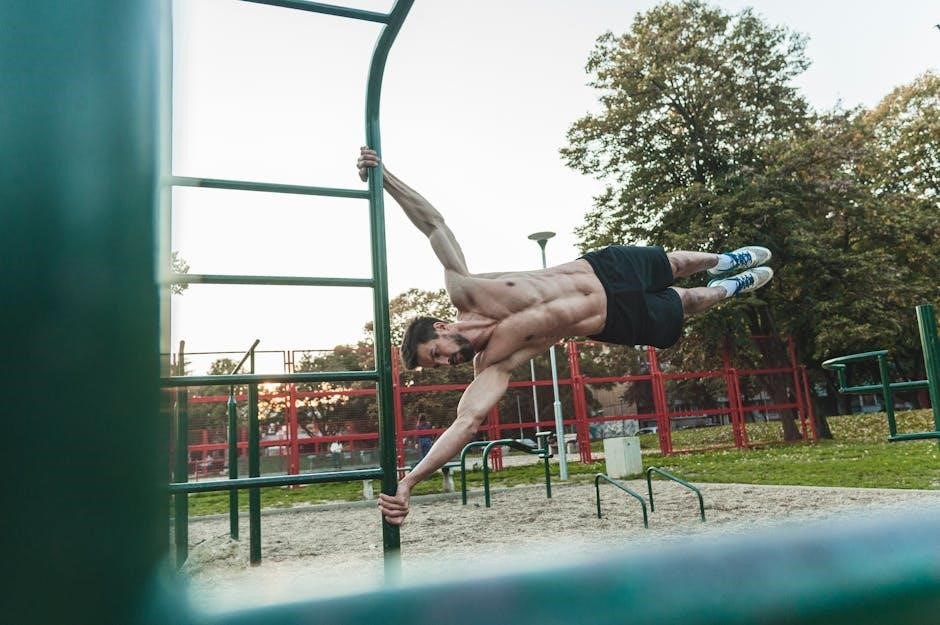
Calisthenics, a dynamic strength training method, leverages bodyweight for full-body exercises, enhancing strength, endurance, and flexibility;
This guide explores building muscle with calisthenics, detailing exercises and a comprehensive one-month workout plan for optimal results.
Rooted in Greek origins – kalos (beauty) and sthenos (strength) – calisthenics focuses on rhythmic movements using only bodyweight.
Modern groups like Bartendaz and Barstarzz exemplify this effective, accessible training, building impressive muscular physiques.
What is Calisthenics?
Calisthenics is a form of strength training distinguished by its reliance on bodyweight as the primary resistance. Unlike weightlifting, which utilizes external loads, calisthenics employs multi-joint, compound movements, engaging multiple muscle groups simultaneously. This approach fosters functional strength, improving real-world physical capabilities.
The term itself originates from the Greek words kalos (beauty) and sthenos (strength), reflecting the historical pursuit of physical perfection through these exercises. Historically, calisthenics served as a foundational element in athletic training and military preparedness, building robust physiques without specialized equipment.
Modern calisthenics extends beyond basic exercises, incorporating advanced skills and progressions. It’s a versatile discipline adaptable to various fitness levels, from beginners performing modified push-ups to advanced practitioners executing complex maneuvers. A well-structured calisthenics workout PDF will demonstrate this progression, guiding individuals towards their fitness goals.
Essentially, calisthenics is about mastering control of your own body, building strength, endurance, flexibility, and coordination through purposeful movement. It’s a testament to the body’s inherent capacity for adaptation and improvement.
The History of Calisthenics
Calisthenics boasts a rich history, tracing back to ancient Greece, where it was integral to physical education and military training. The Greeks valued a balanced physique, and exercises utilizing bodyweight were central to achieving this ideal. Thinkers like Hippocrates advocated for its therapeutic benefits, recognizing its role in maintaining health.
Later, the Persians incorporated similar practices into their warrior training, emphasizing strength and agility. The 19th century saw a revival of interest in calisthenics, particularly through the efforts of Per Henrik Ling, who developed Swedish gymnastics – a system heavily influenced by calisthenic principles.
Throughout the 20th century, calisthenics remained a staple in military fitness programs and school physical education. More recently, the rise of street workout and movements like Barstarzz have popularized modern calisthenics, pushing the boundaries of bodyweight training. A comprehensive calisthenics workout PDF often acknowledges this evolution.
Today, it continues to evolve, blending traditional techniques with innovative progressions, proving its enduring relevance as an effective and accessible fitness modality.
Benefits of Calisthenics Training
Calisthenics offers a multitude of benefits, making it a highly effective training method. It significantly improves strength and endurance, utilizing your own bodyweight as resistance, fostering functional fitness applicable to everyday life. Flexibility and coordination are also enhanced through the diverse range of movements.
Unlike weightlifting, calisthenics requires minimal equipment, making it accessible anywhere, anytime – a key advantage highlighted in many calisthenics workout PDF guides. It promotes a strong mind-muscle connection, improving body awareness and control.
Furthermore, calisthenics is scalable; exercises can be modified to suit all fitness levels, from beginners to advanced athletes. It’s a fantastic way to build lean muscle mass and improve overall physical conditioning. The compound movements engage multiple muscle groups simultaneously, maximizing efficiency.
Ultimately, consistent calisthenics training contributes to improved posture, reduced risk of injury, and a heightened sense of well-being.
Essential Calisthenics Exercises
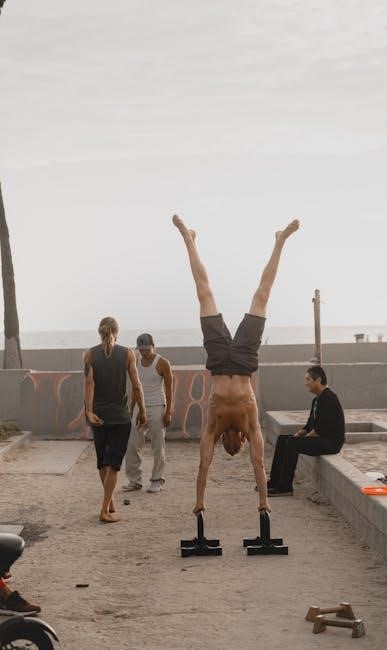
Calisthenics relies on foundational movements like push-ups, squats, pull-ups, dips, and planks, detailed in many calisthenics workout PDF resources.
Mastering these builds a strong base for progression and skill development.
Push-Ups: Variations and Progression
Push-ups are a cornerstone of calisthenics, requiring no equipment and effectively targeting chest, shoulders, and triceps. A calisthenics workout PDF will often detail a progression for all levels.
Beginners can start with incline push-ups (hands elevated) or knee push-ups to reduce resistance. As strength increases, progress to standard push-ups, then decline push-ups (feet elevated) for greater challenge.
Variations like diamond push-ups emphasize triceps, while wide-grip push-ups focus more on the chest. Plyometric push-ups (explosive push-ups) build power. Many calisthenics workout PDF guides include detailed form cues and rep/set recommendations.
Proper form is crucial: maintain a straight line from head to heels, engage your core, and lower your chest towards the ground with controlled movement. Consistent practice and progressive overload are key to building upper body strength.
Squats: Building Lower Body Strength
Squats are fundamental for lower body strength in calisthenics, working quads, hamstrings, and glutes. A well-structured calisthenics workout PDF will incorporate various squat progressions.
Beginners can start with box squats, using a box to control depth and build confidence. Progress to bodyweight squats, focusing on maintaining a straight back and controlled descent. Pistol squats (single-leg squats) are an advanced variation demanding significant strength and balance.
Jump squats add a plyometric element, enhancing power. Bulgarian split squats target each leg individually, improving stability. A calisthenics workout PDF often illustrates proper form, emphasizing a 90-degree angle at the knees.
Focus on engaging your core throughout the movement and driving through your heels. Consistent squatting, with progressive difficulty, is vital for building strong, functional legs.
Pull-Ups: A Cornerstone Exercise
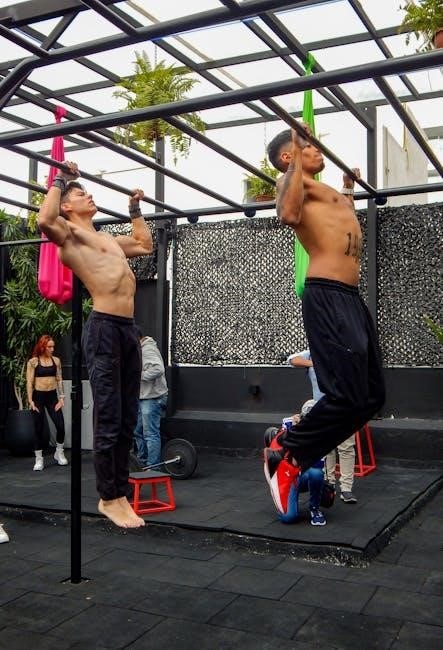
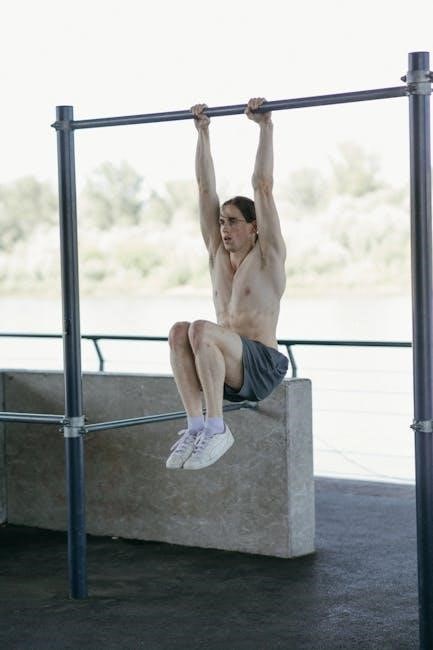
Pull-ups are a cornerstone of calisthenics, effectively targeting back, biceps, and forearms. A comprehensive calisthenics workout PDF will detail progressions for all levels.
If you can’t perform a full pull-up, begin with assisted pull-ups using resistance bands or an assisted pull-up machine. Negative pull-ups – slowly lowering yourself from the top position – build strength. Scapular pull-ups focus on engaging the back muscles.
Once proficient, progress to wide-grip, close-grip, and chin-up variations. A calisthenics workout PDF should emphasize proper form: a full range of motion, controlled movements, and avoiding swinging.
Grip strength is crucial; incorporate grip-strengthening exercises. Consistent practice and progressive overload are key to mastering pull-ups and building a strong upper body.
Dips: Targeting Chest and Triceps
Dips are a powerful calisthenics exercise primarily targeting the chest and triceps, with secondary engagement of the shoulders. A well-structured calisthenics workout PDF will incorporate dips with appropriate progressions.
Beginners can start with bench dips, utilizing a stable surface for support. As strength increases, progress to parallel bar dips, maintaining a controlled descent and ascent. Leaning forward emphasizes chest activation, while keeping the body upright focuses on the triceps.
A calisthenics workout PDF should highlight the importance of full range of motion – lowering until your elbows reach a 90-degree angle. Weighted dips, using a dip belt, provide an additional challenge.
Prioritize proper form to prevent shoulder injuries. Consistent practice and progressive overload are essential for maximizing results and building upper body strength.
Plank: Core Stability and Endurance
Planks are a foundational calisthenics exercise crucial for developing core stability and endurance, a key component of any effective calisthenics workout PDF. Unlike dynamic movements, planks are an isometric hold, challenging your core to maintain a rigid position.
Proper form is paramount: maintain a straight line from head to heels, engaging your abs, glutes, and quads; Avoid sagging hips or a raised back. A calisthenics workout PDF should detail variations like forearm planks, high planks, and side planks.
Beginners can start with shorter holds, gradually increasing duration as strength improves. Advanced variations include plank jacks, plank with arm/leg lifts, and weighted planks.
Integrating planks into your routine enhances overall body control and prevents injuries. Consistent practice builds a strong core, improving performance in other calisthenics exercises.
Creating a Calisthenics Workout PDF
Calisthenics workout PDFs should include structured plans, warm-up routines, and cool-down stretches for optimal results and injury prevention.
Effective plans balance exercises, progressively increasing difficulty to build strength and endurance.
Structuring Your Workout Plan
A well-structured calisthenics workout plan is paramount for achieving consistent progress and avoiding plateaus. Begin by defining your fitness goals – are you aiming for strength, endurance, or skill development? This will dictate exercise selection and intensity.
Divide your workouts into focused sessions targeting specific muscle groups or movement patterns. A common split includes push days (chest, shoulders, triceps), pull days (back, biceps), and leg days. Incorporate full-body sessions for a balanced approach.
Prioritize compound exercises like push-ups, squats, and pull-ups, as they engage multiple muscle groups simultaneously. Supplement these with isolation exercises to address specific weaknesses. Remember, a progressive overload is key – gradually increase repetitions, sets, or exercise difficulty over time.
Consider incorporating rest days to allow your muscles to recover and rebuild. A calisthenics workout PDF should clearly outline the workout schedule, exercises, sets, reps, and rest periods for each session, ensuring clarity and consistency.
Warm-up Routine for Calisthenics
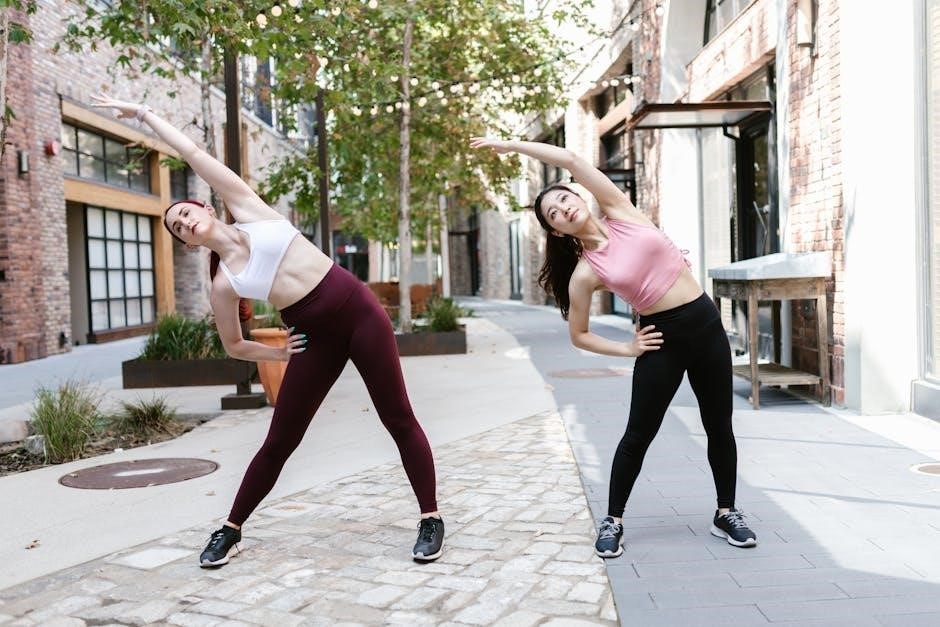
A comprehensive warm-up is crucial before any calisthenics workout, preparing your muscles and joints for the demands ahead and minimizing injury risk. Begin with 5-10 minutes of light cardio, such as jogging in place or jumping jacks, to elevate your heart rate and increase blood flow.
Follow this with dynamic stretching, focusing on movements that mimic the exercises you’ll be performing. Include arm circles, leg swings, torso twists, and wrist rotations. Dynamic stretches improve range of motion and flexibility.
Specific warm-up exercises should target the muscle groups you’ll be using. For example, before push-ups, perform arm circles and shoulder rotations. Before squats, do leg swings and hip circles.
A calisthenics workout PDF should detail a specific warm-up routine, ensuring you’re adequately prepared for each session. Prioritize controlled movements and listen to your body, avoiding any pain.
Cool-down and Stretching
A proper cool-down is essential after a calisthenics workout to gradually lower your heart rate and prevent muscle soreness. Begin with 5-10 minutes of light cardio, like walking, to help your body transition back to a resting state.
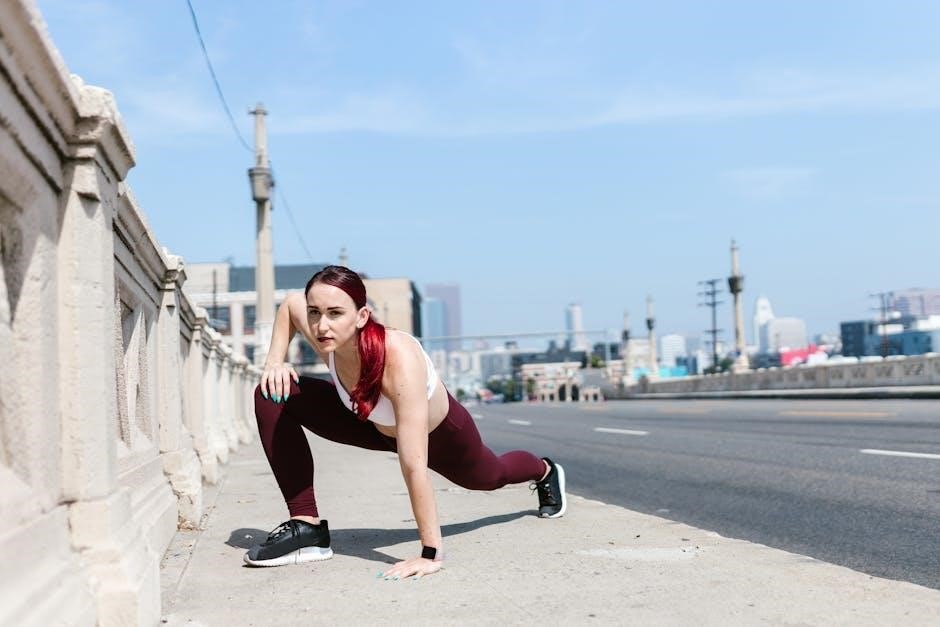
Following cardio, incorporate static stretching, holding each stretch for 20-30 seconds. Focus on the muscle groups you worked during your session, such as chest, back, legs, and core. Static stretches improve flexibility and reduce muscle tension.
Examples include holding a triceps stretch, hamstring stretch, or quad stretch. Deep breathing during stretches can further enhance relaxation and recovery.
A well-designed calisthenics workout PDF will include a dedicated cool-down and stretching section. Remember to stretch gently and avoid bouncing, which can cause injury. Prioritize full-body recovery for optimal results.

Calisthenics Workout Plans

Calisthenics workout PDFs often feature tiered plans – beginner, intermediate, and advanced – progressively increasing difficulty.
These plans detail exercises, sets, reps, and rest times, guiding users toward strength and skill development.
Beginner Calisthenics Workout (4 Weeks)
Week 1-2: Foundation Building – Focus on mastering basic movements. Perform 3 sets of 8-12 repetitions for each exercise. Include: Incline Push-ups (against a wall or elevated surface), Bodyweight Squats, Plank (hold for 30-60 seconds), and Assisted Pull-ups (using a resistance band or assisted pull-up machine). Rest for 60-90 seconds between sets.
Week 3-4: Increasing Volume – Gradually increase the difficulty and volume. Perform 3-4 sets of 10-15 repetitions. Exercises include: Knee Push-ups, Regular Squats, Plank (hold for 45-75 seconds), and Negative Pull-ups (slowly lowering yourself from the top position). Introduce Bird Dogs (10-12 reps per side) for core stability. Rest for 45-60 seconds between sets.
Important Considerations: Prioritize proper form over quantity. Listen to your body and take rest days when needed. A calisthenics workout PDF should include detailed instructions and modifications for each exercise to ensure safety and effectiveness. Remember to warm up before each workout and cool down afterward with static stretching.
Intermediate Calisthenics Workout (4 Weeks)
Week 1-2: Strength Endurance – Increase intensity with 3-4 sets of 12-15 repetitions. Exercises: Standard Push-ups, Jump Squats, Plank (hold for 60-90 seconds), and Pull-up negatives (focus on controlled descent). Add Dips using parallel bars or sturdy chairs. Rest for 60 seconds between sets.
Week 3-4: Building Power – Introduce more challenging variations. Perform 4 sets of 8-12 repetitions. Include: Decline Push-ups, Pistol Squat progressions (assisted if needed), Plank variations (side plank, plank with leg lift), and Assisted Chin-ups. Incorporate L-sit progressions. Rest for 75-90 seconds between sets.
A comprehensive calisthenics workout PDF should detail proper form and scaling options. Focus on controlled movements and full range of motion. Prioritize core engagement throughout each exercise. Remember adequate rest and nutrition are crucial for recovery and progress.
Advanced Calisthenics Workout (4 Weeks)
Week 1-2: Skill Focus & Strength – 5 sets of 6-8 repetitions. Exercises: One-Arm Push-up progressions, Pistol Squats (unassisted), Muscle-up negatives, Front Lever progressions (tucked or advanced), and Handstand Push-up progressions. Rest 90-120 seconds between sets.
Week 3-4: Max Strength & Control – 4 sets of 4-6 repetitions with added weight (vest or backpack). Include: Planche progressions, Full Range of Motion Muscle-ups, Weighted Dips, and Handstand Push-ups. Focus on explosive power and precise form.
A detailed calisthenics workout PDF for this level should emphasize proper technique to prevent injury. Prioritize dynamic stretching and mobility work. This phase demands significant recovery; ensure adequate sleep and nutrition. Consider incorporating active recovery days with light cardio or yoga.
Progressive Overload in Calisthenics
Progressive overload, crucial for gains, involves gradually increasing challenge via repetitions, sets, or exercise variations.
A calisthenics workout PDF should detail these methods, ensuring continuous adaptation and strength development over time.
Increasing Repetitions
Increasing repetitions is the most straightforward method of progressive overload within a calisthenics workout PDF. Once you can comfortably perform a set number of repetitions with good form, the next step is to incrementally increase that number.
For example, if your PDF outlines a plan for 3 sets of 8 push-ups, and you find yourself easily completing all sets and reps, aim for 3 sets of 9, then 10, and so on. This gradual increase forces your muscles to adapt and grow stronger.
A well-designed calisthenics workout PDF will clearly indicate the target repetition ranges for each exercise and provide guidance on when and how to increase them. It’s vital to prioritize maintaining proper form throughout this process; sacrificing technique for higher reps can lead to injury.

Remember, small, consistent increases are more effective than attempting large jumps in repetitions. Listen to your body and adjust accordingly, ensuring you’re challenging yourself without overexertion.
Adding Sets
Following repetition increases, adding sets represents the next logical progression in a calisthenics workout PDF. Increasing the volume of work performed challenges your muscles further, promoting continued strength gains and endurance development.
If your PDF initially prescribes 3 sets of an exercise, and you’ve comfortably reached the upper end of the repetition range, consider adding a fourth set. This increases the overall workload without necessarily altering the difficulty of each individual repetition.
A comprehensive calisthenics workout PDF will often outline a progression scheme, indicating when to add sets based on your performance. Prioritize maintaining consistent form across all sets; fatigue can compromise technique as you progress.
Gradually increase the number of sets, allowing your body to adapt. For instance, move from 3 to 4 sets, then to 5. Remember to balance increased volume with adequate rest to prevent overtraining and maximize recovery.
Exploring Exercise Variations
A well-structured calisthenics workout PDF shouldn’t remain static; exploring exercise variations is crucial for continued progress and preventing plateaus. Modifying exercises alters the stimulus, challenging your muscles in new ways and fostering comprehensive development.
For example, progress from standard push-ups to incline, decline, or diamond push-ups. Squats can evolve into pistol squats or jump squats. These variations demand greater strength, stability, and coordination.
Your calisthenics workout PDF should ideally include a progression chart detailing variations for each core exercise. This allows you to systematically increase difficulty as your strength improves.
Variations also address muscle imbalances and enhance functional fitness. They prevent overuse injuries by distributing stress across different muscle groups. Remember to master the foundational exercise before attempting more complex variations, prioritizing proper form throughout.
Calisthenics Skills and Progression
Calisthenics skills, ranging from basic to advanced, build upon foundational strength; a calisthenics workout PDF should outline a clear progression path.
Skill lists, with over 40 exercises, guide beginners to professionals, fostering strength, power, and coordination through dedicated practice.
Basic Calisthenics Skills
Fundamental movements form the bedrock of any successful calisthenics journey, and a well-structured calisthenics workout PDF will prioritize mastering these initially. These skills aren’t just exercises; they’re building blocks for more complex feats of strength and control.
Begin with a solid foundation in push-ups – starting with wall push-ups, progressing to knee push-ups, and ultimately achieving full push-ups. Simultaneously, develop lower body strength through squats, focusing on proper form to avoid injury. Mastering the plank is crucial for core stability, holding for increasing durations.
Pull-ups, while challenging, are a cornerstone skill; assisted pull-ups using resistance bands or a spotter are excellent starting points. Inverted rows, performed under a sturdy table or bar, offer a more accessible alternative. These basic skills, consistently practiced, will dramatically improve your overall strength and prepare you for intermediate progressions detailed in a comprehensive calisthenics workout PDF.
Remember, consistency and proper form are paramount!
Intermediate Calisthenics Skills
Once a solid foundation of basic skills is established – as outlined in a beginner-friendly calisthenics workout PDF – it’s time to elevate your training. Intermediate skills demand greater strength, coordination, and body control, pushing you closer to advanced movements.
Progress beyond standard push-ups with diamond push-ups and archer push-ups, targeting different muscle groups. Explore pistol squats (single-leg squats) for enhanced lower body strength and balance. Refine your pull-up technique with chin-ups and wide-grip pull-ups.
Introduce dips, utilizing parallel bars or sturdy chairs, to effectively target the chest and triceps. Begin working towards leg raises and L-sits to build core strength and stability. A well-designed calisthenics workout PDF will incorporate these skills progressively, ensuring proper form and minimizing injury risk. Remember to prioritize controlled movements and consistent practice.
These skills bridge the gap to more complex calisthenics feats.
Advanced Calisthenics Skills
Mastering advanced calisthenics skills signifies a high level of strength, control, and dedication, often detailed within comprehensive calisthenics workout PDF guides. These movements require significant practice and a strong foundation built from beginner and intermediate progressions.
Iconic skills include the muscle-up, a dynamic combination of a pull-up and dip, demanding explosive power. Front levers and back levers showcase exceptional core and back strength, requiring precise body positioning. Handstand push-ups build shoulder strength and stability, progressing from wall-assisted variations.
Explore variations like the one-arm push-up, a testament to unilateral strength, and the human flag, demonstrating incredible core and grip strength. A detailed calisthenics workout PDF will emphasize proper form and progressive overload to safely achieve these challenging skills. Remember consistent training and patience are key.

These skills represent the pinnacle of bodyweight mastery.
Resources for Calisthenics Workouts
Calisthenics workout PDFs, online communities, and equipment (optional) provide support and guidance. Explore guides from Barstarzz and Street Workout Ukraine!
Connect with fellow enthusiasts for motivation and shared learning experiences, enhancing your training journey.
Online Calisthenics Communities
Engaging with online calisthenics communities is invaluable for motivation, learning, and progress tracking. These platforms offer a space to connect with individuals sharing a passion for bodyweight training, fostering a supportive environment for all skill levels.
Numerous forums and social media groups, like those associated with Barstarzz, Bar-Barians, and Street Workout Ukraine, provide access to a wealth of information, including workout routines, technique tutorials, and nutritional advice. Members frequently share their personal journeys, offering encouragement and accountability.
Finding a community allows you to ask questions, receive feedback on your form, and discover new exercises or progressions. Many groups host challenges and events, adding a competitive element and further boosting motivation. Utilizing these resources can significantly enhance your understanding and enjoyment of calisthenics, ultimately accelerating your results. Don’t hesitate to explore and find the community that best suits your needs and goals!
Recommended Calisthenics PDF Guides
Numerous calisthenics PDF guides are available online, offering structured workout plans and detailed exercise progressions. These resources can be particularly helpful for beginners seeking a clear roadmap to follow, or for experienced practitioners looking to refine their training.
Many guides focus on specific skill development, such as handstands, muscle-ups, or front levers, providing step-by-step instructions and drills. Others offer comprehensive programs covering all aspects of calisthenics training, including warm-ups, cool-downs, and progressive overload strategies.
When selecting a guide, consider your current fitness level and goals. Look for resources created by qualified instructors with a proven track record. Free guides can be a good starting point, but premium options often offer more in-depth content and personalized support. Remember to prioritize proper form and listen to your body throughout your training journey. A well-chosen PDF can be a valuable asset in achieving your calisthenics aspirations!
Calisthenics Equipment (Optional)
While calisthenics primarily relies on bodyweight, certain equipment can enhance your training and unlock new possibilities. A pull-up bar is arguably the most versatile addition, enabling exercises like pull-ups, chin-ups, and muscle-up progressions.
Resistance bands offer adjustable assistance for exercises like pull-ups or dips, or can be used to increase the challenge of bodyweight movements. Gymnastic rings provide instability, forcing greater muscle activation and improving coordination. Parallettes are useful for developing wrist strength and performing advanced push-up variations.
However, remember that equipment isn’t essential. Many effective calisthenics workouts can be performed with minimal or no gear. Prioritize mastering fundamental movements before investing in equipment. When choosing equipment, prioritize quality and safety. A solid pull-up bar and durable resistance bands are excellent starting points for elevating your calisthenics journey.